Sidebar
A composable, themeable and customizable sidebar component.
Sidebars are one of the most complex components to build. They are central to any application and often contain a lot of moving parts.
I (shadcn) don't like building sidebars. So I (shadcn) built 30+ of them. All kinds of
configurations. Then I (shadcn) extracted the core components into sidebar.tsx.
We now have a solid foundation to build on top of. Composable. Themeable. Customizable.
Installation
Run the following command to install sidebar.tsx
npx nore-ui-cli@latest add sidebarAdd the following colors to your semantic tokens.
export const semanticTokens = defineSemanticTokens({
  colors: {
    // ... other colors
    sidebar: {
      DEFAULT: { value: { base: "{colors.zinc.100}", _dark: "{colors.zinc.900}" } },
      fg: { value: { base: "{colors.zinc.950}", _dark: "{colors.zinc.50}" } },
      primary: {
        DEFAULT: { value: { base: "{colors.zinc.900}", _dark: "{colors.zinc.100}" } },
        fg: { value: { base: "{colors.zinc.50}", _dark: "{colors.zinc.900}" } },
      },
      accent: {
        DEFAULT: { value: { base: "{colors.zinc.100}", _dark: "{colors.zinc.800}" } },
        fg: { value: { base: "{colors.zinc.900}", _dark: "{colors.zinc.50}" } },
      },
      border: { value: { base: "{colors.zinc.200}", _dark: "{colors.zinc.800}" } },
      ring: { value: { base: "{colors.zinc.900}", _dark: "{colors.zinc.50}" } },
    },
  },
});
Structure
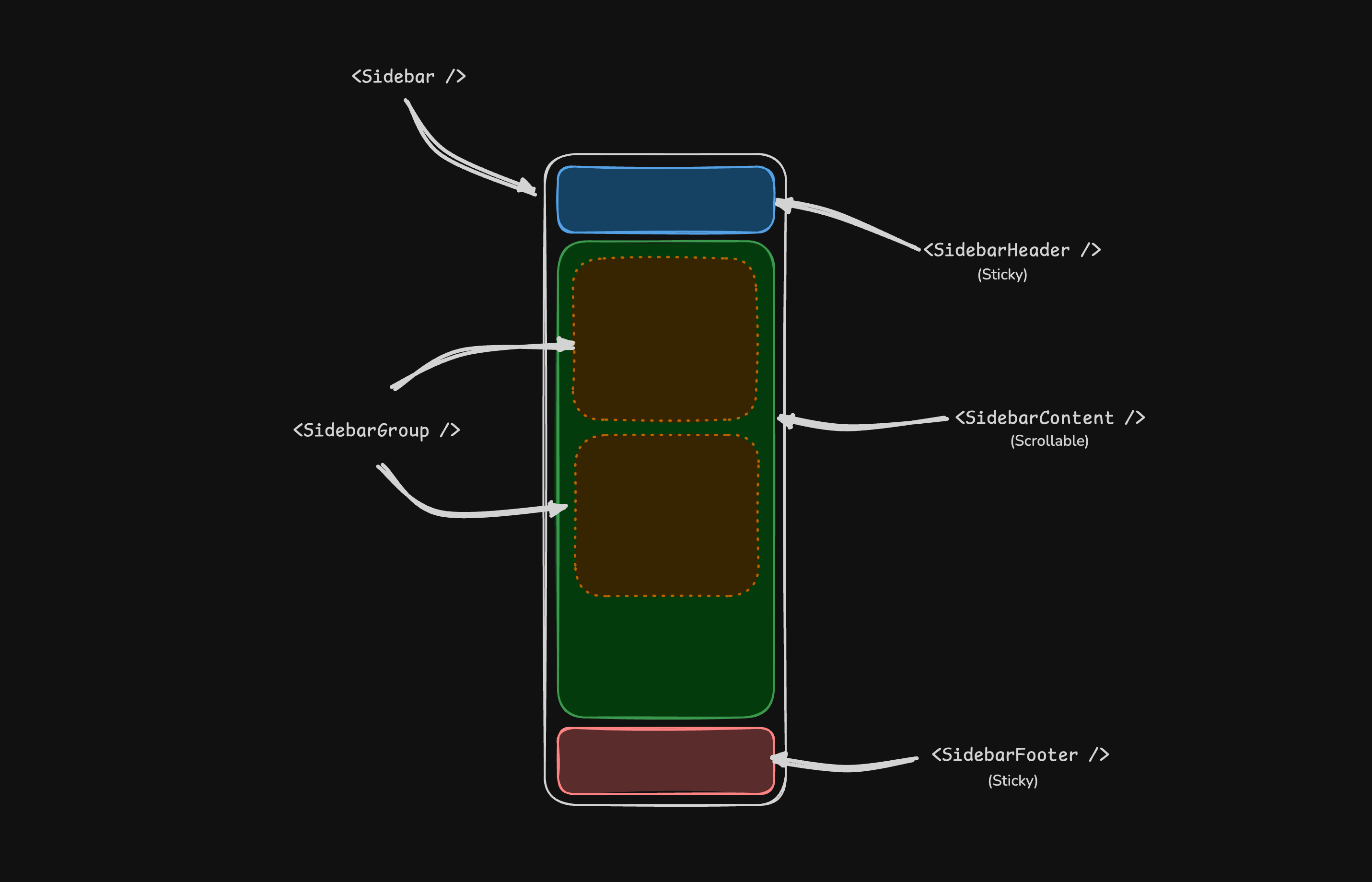
A Sidebar component is composed of the following parts:
SidebarProvider- Handles collapsible state.Sidebar- The sidebar container.SidebarHeaderandSidebarFooter- Sticky at the top and bottom of the sidebar.SidebarContent- Scrollable content.SidebarGroup- Section within theSidebarContent.SidebarTrigger- Trigger for theSidebar.
Usage
app/layout.tsx
import { AppSidebar } from "@/components/app-sidebar";
import { SidebarProvider, SidebarTrigger } from "@/components/ui/sidebar";

export default function Layout({ children }: { children: React.ReactNode }) {
  return (
    <SidebarProvider>
      <AppSidebar />
      <main>
        <SidebarTrigger />
        {children}
      </main>
    </SidebarProvider>
  );
}
components/app-sidebar.tsx
import {
  Sidebar,
  SidebarContent,
  SidebarFooter,
  SidebarGroup,
  SidebarHeader,
} from "@/components/ui/sidebar";

export function AppSidebar() {
  return (
    <Sidebar>
      <SidebarHeader />
      <SidebarContent>
        <SidebarGroup />
        <SidebarGroup />
      </SidebarContent>
      <SidebarFooter />
    </Sidebar>
  );
}
Your First Sidebar
Let's start with the most basic sidebar. A collapsible sidebar with a menu.
Add a SidebarProvider and SidebarTrigger at the root of your application.
app/layout.tsx
import { AppSidebar } from "@/components/app-sidebar";
import { SidebarProvider, SidebarTrigger } from "@/components/ui/sidebar";

export default function Layout({ children }: { children: React.ReactNode }) {
  return (
    <SidebarProvider>
      <AppSidebar />
      <main>
        <SidebarTrigger />
        {children}
      </main>
    </SidebarProvider>
  );
}
Create a new sidebar component at components/app-sidebar.tsx.
components/app-sidebar.tsx
import { Sidebar, SidebarContent } from "@/components/ui/sidebar";

export function AppSidebar() {
  return (
    <Sidebar>
      <SidebarContent />
    </Sidebar>
  );
}
Now, let's add a SidebarMenu to the sidebar.
We'll use the SidebarMenu component in a SidebarGroup.
components/app-sidebar.tsx
import { LuCalendar, LuHouse, LuInbox, LuSearch, LuSettings } from "react-icons/lu";
import {
  Sidebar,
  SidebarContent,
  SidebarGroup,
  SidebarGroupContent,
  SidebarGroupLabel,
  SidebarMenu,
  SidebarMenuButton,
  SidebarMenuItem,
} from "@/components/ui/sidebar";

// Menu items.
const items = [
  {
    title: "Home",
    url: "#",
    icon: LuHouse,
  },
  {
    title: "Inbox",
    url: "#",
    icon: LuInbox,
  },
  {
    title: "Calendar",
    url: "#",
    icon: LuCalendar,
  },
  {
    title: "Search",
    url: "#",
    icon: LuSearch,
  },
  {
    title: "Settings",
    url: "#",
    icon: LuSettings,
  },
];

export function AppSidebar() {
  return (
    <Sidebar>
      <SidebarContent>
        <SidebarGroup>
          <SidebarGroupLabel>Application</SidebarGroupLabel>
          <SidebarGroupContent>
            <SidebarMenu>
              {items.map((item) => (
                <SidebarMenuItem key={item.title}>
                  <SidebarMenuButton asChild>
                    <a href={item.url}>
                      <item.icon />
                      <span>{item.title}</span>
                    </a>
                  </SidebarMenuButton>
                </SidebarMenuItem>
              ))}
            </SidebarMenu>
          </SidebarGroupContent>
        </SidebarGroup>
      </SidebarContent>
    </Sidebar>
  );
}
You've created your first sidebar.
Components
The components in sidebar.tsx are built to be composable i.e you build your sidebar by putting the provided components together. They also compose well with other shadcn/ui components such as DropdownMenu, Collapsible or Dialog etc.
If you need to change the code in sidebar.tsx, you are encouraged to do so. The code is yours. Use sidebar.tsx as a starting point and build your own.
In the next sections, we'll go over each component and how to use them.
SidebarProvider
The SidebarProvider component is used to provide the sidebar context to the Sidebar component. You should always wrap your application in a SidebarProvider component.
SidebarProvider Props
| Name | Type | Description |
|---|---|---|
defaultOpen | boolean | Default open state of the sidebar. |
open | boolean | Open state of the sidebar (controlled). |
onOpenChange | (open: boolean) => void | Sets open state of the sidebar (controlled). |
Width
If you have a single sidebar in your application, you can use the SIDEBAR_WIDTH and SIDEBAR_WIDTH_MOBILE variables in sidebar.tsx to set the width of the sidebar.
components/ui/sidebar.tsx
const SIDEBAR_WIDTH = "16rem";
const SIDEBAR_WIDTH_MOBILE = "18rem";
For multiple sidebars in your application, you can use the style prop to set the width of the sidebar.
To set the width of the sidebar, you can use the --sidebar-width and --sidebar-width-mobile CSS variables in the style prop.
components/ui/sidebar.tsx
<SidebarProvider
  style={{
    "--sidebar-width": "20rem",
    "--sidebar-width-mobile": "20rem",
  }}
>
  <Sidebar />
</SidebarProvider>
This will handle the width of the sidebar but also the layout spacing.
Keyboard Shortcut
The SIDEBAR_KEYBOARD_SHORTCUT variable is used to set the keyboard shortcut used to open and close the sidebar.
To trigger the sidebar, you use the cmd+b keyboard shortcut on Mac and ctrl+b on Windows.
You can change the keyboard shortcut by updating the SIDEBAR_KEYBOARD_SHORTCUT variable.
components/ui/sidebar.tsx
const SIDEBAR_KEYBOARD_SHORTCUT = "b";
Persisted State
The SidebarProvider supports persisting the sidebar state across page reloads and server-side rendering. It uses cookies to store the current state of the sidebar. When the sidebar state changes, a default cookie named sidebar_state is set with the current open/closed state. This cookie is then read on subsequent page loads to restore the sidebar state.
To persist sidebar state in Next.js, set up your SidebarProvider in app/layout.tsx like this:
app/layout.tsx
import { cookies } from "next/headers";
import { AppSidebar } from "@/components/app-sidebar";
import { SidebarProvider, SidebarTrigger } from "@/components/ui/sidebar";

export async function Layout({ children }: { children: React.ReactNode }) {
  const cookieStore = await cookies();
  const defaultOpen = cookieStore.get("sidebar_state")?.value === "true";

  return (
    <SidebarProvider defaultOpen={defaultOpen}>
      <AppSidebar />
      <main>
        <SidebarTrigger />
        {children}
      </main>
    </SidebarProvider>
  );
}
You can change the name of the cookie by updating the SIDEBAR_COOKIE_NAME variable in sidebar.tsx.
components/ui/sidebar.tsx
const SIDEBAR_COOKIE_NAME = "sidebar_state";
Sidebar
The main Sidebar component used to render a collapsible sidebar.
import { Sidebar } from "@/components/ui/sidebar";

export function AppSidebar() {
  return <Sidebar />;
}
Sidebar Props
| Property | Type | Description |
|---|---|---|
side | left or right | The side of the sidebar. |
variant | sidebar, floating, or inset | The variant of the sidebar. |
collapsible | offcanvas, icon, or none | Collapsible state of the sidebar. |
side
Use the side prop to change the side of the sidebar.
Available options are left and right.
import { Sidebar } from "@/components/ui/sidebar";

export function AppSidebar() {
  return <Sidebar side="left | right" />;
}
variant
Use the variant prop to change the variant of the sidebar.
Available options are sidebar, floating and inset.
import { Sidebar } from "@/components/ui/sidebar";

export function AppSidebar() {
  return <Sidebar variant="sidebar | floating | inset" />;
}
Note: If you use the inset variant, remember to wrap your main content in a SidebarInset
component.
<SidebarProvider>
  <Sidebar variant="inset" />
  <SidebarInset>
    <main>{children}</main>
  </SidebarInset>
</SidebarProvider>
collapsible
Use the collapsible prop to make the sidebar collapsible.
Available options are offcanvas, icon and none.
import { Sidebar } from "@/components/ui/sidebar";

export function AppSidebar() {
  return <Sidebar collapsible="offcanvas | icon | none" />;
}
| Prop | Description |
|---|---|
offcanvas | A collapsible sidebar that slides in from the left or right. |
icon | A sidebar that collapses to icons. |
none | A non-collapsible sidebar. |
useSidebar
The useSidebar hook is used to control the sidebar.
import { useSidebar } from "@/components/ui/sidebar";

export function AppSidebar() {
  const { state, open, setOpen, openMobile, setOpenMobile, isMobile, toggleSidebar } = useSidebar();
}
| Property | Type | Description |
|---|---|---|
state | expanded or collapsed | The current state of the sidebar. |
open | boolean | Whether the sidebar is open. |
setOpen | (open: boolean) => void | Sets the open state of the sidebar. |
openMobile | boolean | Whether the sidebar is open on mobile. |
setOpenMobile | (open: boolean) => void | Sets the open state of the sidebar on mobile. |
isMobile | boolean | Whether the sidebar is on mobile. |
toggleSidebar | () => void | Toggles the sidebar. Desktop and mobile. |
SidebarHeader
Use the SidebarHeader component to add a sticky header to the sidebar.
The following example adds a <DropdownMenu> to the SidebarHeader.
SidebarFooter
Use the SidebarFooter component to add a sticky footer to the sidebar.
The following example adds a <DropdownMenu> to the SidebarFooter.
SidebarContent
The SidebarContent component is used to wrap the content of the sidebar. This is where you add your SidebarGroup components. It is scrollable.
import { Sidebar, SidebarContent } from "@/components/ui/sidebar";

export function AppSidebar() {
  return (
    <Sidebar>
      <SidebarContent>
        <SidebarGroup />
        <SidebarGroup />
      </SidebarContent>
    </Sidebar>
  );
}
SidebarGroup
Use the SidebarGroup component to create a section within the sidebar.
A SidebarGroup has a SidebarGroupLabel, a SidebarGroupContent and an optional SidebarGroupAction.
Collapsible SidebarGroup
To make a SidebarGroup collapsible, wrap it in a Collapsible.
Note: We wrap the CollapsibleTrigger in a SidebarGroupLabel to render a button.
SidebarGroupAction
Use the SidebarGroupAction component to add an action button to the SidebarGroup.
export function AppSidebar() {
  return (
    <SidebarGroup>
      <SidebarGroupLabel asChild>Projects</SidebarGroupLabel>
      <SidebarGroupAction title="Add Project">
        <Plus /> <span className="sr-only">Add Project</span>
      </SidebarGroupAction>
      <SidebarGroupContent />
    </SidebarGroup>
  );
}
SidebarMenu
The SidebarMenu component is used for building a menu within a SidebarGroup.
A SidebarMenu component is composed of SidebarMenuItem, SidebarMenuButton, <SidebarMenuAction /> and <SidebarMenuSub /> components.
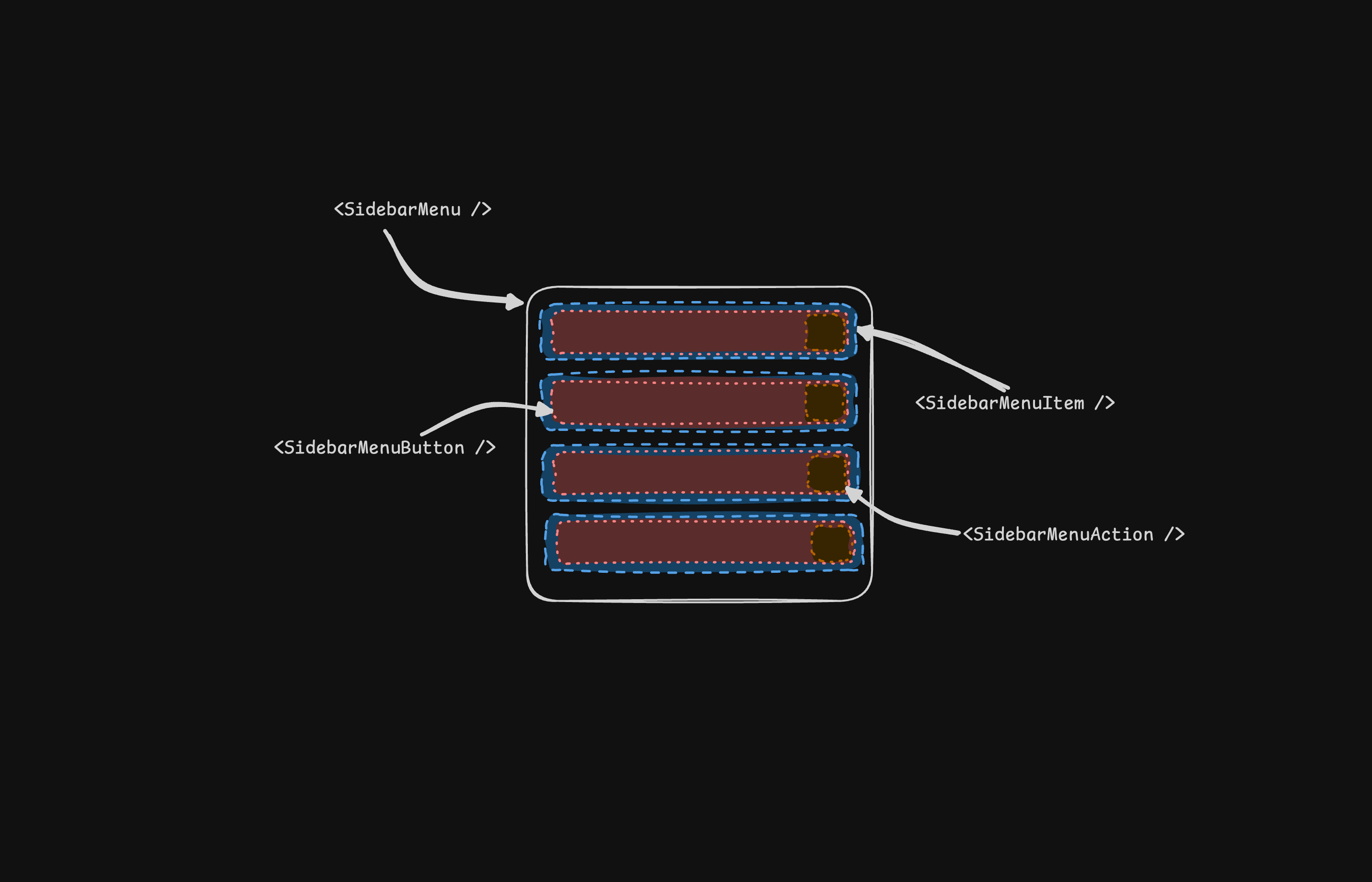
Here's an example of a SidebarMenu component rendering a list of projects.
SidebarMenuButton
The SidebarMenuButton component is used to render a menu button within a SidebarMenuItem.
Link or Anchor
By default, the SidebarMenuButton renders a button but you can use the asChild prop to render a different component such as a Link or an a tag.
<SidebarMenuButton asChild>
  <a href="#">Home</a>
</SidebarMenuButton>
Icon and Label
You can render an icon and a truncated label inside the button. Remember to wrap the label in a <span>.
<SidebarMenuButton asChild>
  <a href="#">
    <Home />
    <span>Home</span>
  </a>
</SidebarMenuButton>
isActive
Use the isActive prop to mark a menu item as active.
<SidebarMenuButton asChild isActive>
  <a href="#">Home</a>
</SidebarMenuButton>
SidebarMenuAction
The SidebarMenuAction component is used to render a menu action within a SidebarMenuItem.
This button works independently of the SidebarMenuButton i.e you can have the <SidebarMenuButton /> as a clickable link and the <SidebarMenuAction /> as a button.
<SidebarMenuItem>
  <SidebarMenuButton asChild>
    <a href="#">
      <Home />
      <span>Home</span>
    </a>
  </SidebarMenuButton>
  <SidebarMenuAction>
    <Plus /> <span className="sr-only">Add Project</span>
  </SidebarMenuAction>
</SidebarMenuItem>
DropdownMenu
Here's an example of a SidebarMenuAction component rendering a DropdownMenu.
SidebarMenuSub
The SidebarMenuSub component is used to render a submenu within a SidebarMenu.
Use <SidebarMenuSubItem /> and <SidebarMenuSubButton /> to render a submenu item.
Collapsible SidebarMenu
To make a SidebarMenu component collapsible, wrap it and the SidebarMenuSub components in a Collapsible.
SidebarMenuBadge
The SidebarMenuBadge component is used to render a badge within a SidebarMenuItem.
SidebarMenuSkeleton
The SidebarMenuSkeleton component is used to render a skeleton for a SidebarMenu. You can use this to show a loading state when using React Server Components, SWR or react-query.
function NavProjectsSkeleton() {
  return (
    <SidebarMenu>
      {Array.from({ length: 5 }).map((_, index) => (
        <SidebarMenuItem key={index}>
          <SidebarMenuSkeleton />
        </SidebarMenuItem>
      ))}
    </SidebarMenu>
  );
}
SidebarSeparator
The SidebarSeparator component is used to render a separator within a Sidebar.
<Sidebar>
  <SidebarHeader />
  <SidebarSeparator />
  <SidebarContent>
    <SidebarGroup />
    <SidebarSeparator />
    <SidebarGroup />
  </SidebarContent>
</Sidebar>
SidebarTrigger
Use the SidebarTrigger component to render a button that toggles the sidebar.
The SidebarTrigger component must be used within a SidebarProvider.
<SidebarProvider>
  <Sidebar />
  <main>
    <SidebarTrigger />
  </main>
</SidebarProvider>
Custom Trigger
To create a custom trigger, you can use the useSidebar hook.
import { useSidebar } from "@/components/ui/sidebar";

export function CustomTrigger() {
  const { toggleSidebar } = useSidebar();

  return <button onClick={toggleSidebar}>Toggle Sidebar</button>;
}
SidebarRail
The SidebarRail component is used to render a rail within a Sidebar. This rail can be used to toggle the sidebar.
<Sidebar>
  <SidebarHeader />
  <SidebarContent>
    <SidebarGroup />
  </SidebarContent>
  <SidebarFooter />
  <SidebarRail />
</Sidebar>
Controlled Sidebar
Use the open and onOpenChange props to control the sidebar.